
Template: Plain HTML
Table of contents
Example I: Basic example
- location:
examples/html/websockets.html - technology: pure html + JS using websocket communication
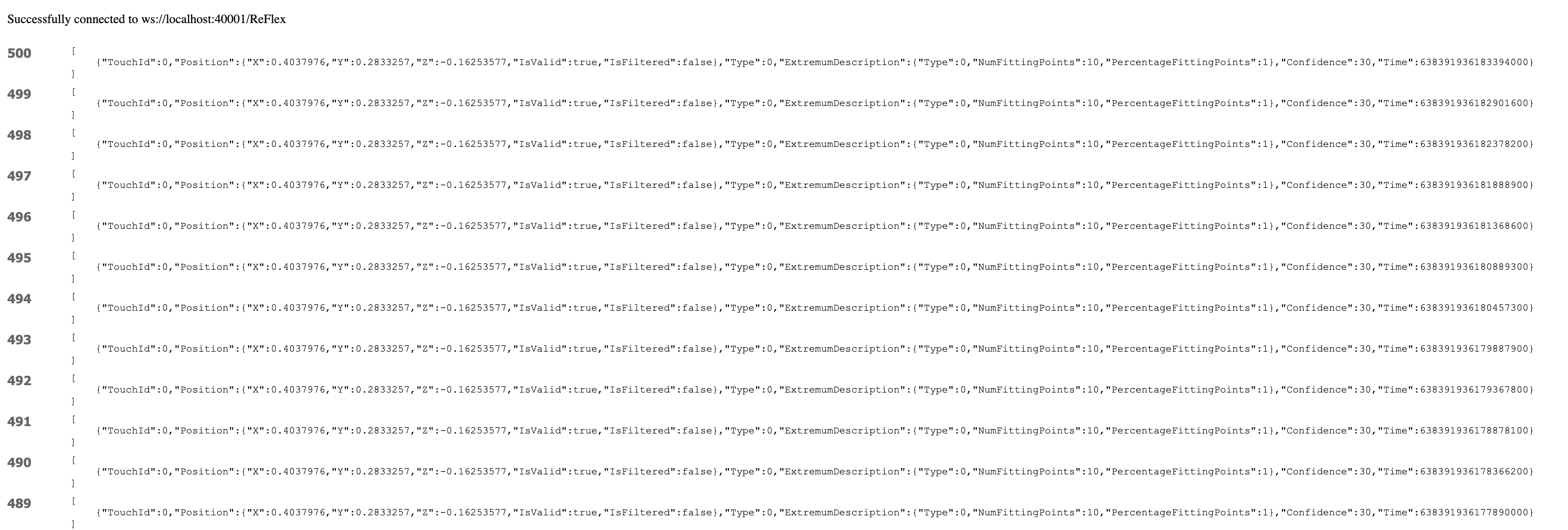
- preconfigured websocket address (for setup in
Server):ws://localhost:40041/reflex - logs websocket messages to the screen (limited to last 100 messages, ordered chronologically)
- most basic example for testing and understanding structure of received interaction data
Code
To receive interactions from ReFlex framework, simply open a new WebSocket connection and handle onmessage events of the WebSocket.
1
2
3
4
5
6
7
8
9
10
11
12
13
14
15
16
17
18
19
20
21
22
23
24
25
26
27
28
29
30
31
32
    // Let us open a web socket
    const ws = new WebSocket(address);

    // event when connection to websocket is established
    ws.onopen = function() {

        // ...

    };

    // event when websocket receives new interactions
    ws.onmessage = function (evt) {

        // evt.data contains interactions from ReFlex framework
        const received_interactions = evt.data;

        // handle interactions update

    };

    // event when websocket connection is terminated
    ws.onclose = function() {

        // websocket is closed.

    };

    // event for websocket error handling
    ws.onerror = function (error) {

        // handle error (log, reconnect, ...)
    }
Example II: Logging and visualization
- location:
examples/html/websockets_with_logging.html - technology: pure html + JS using websocket communication, logs messages to logging service (if running in parallel)
- preconfigured websocket address (for setup in
Server):ws://localhost:40041/reflex - preconfigured address for logging (default address in
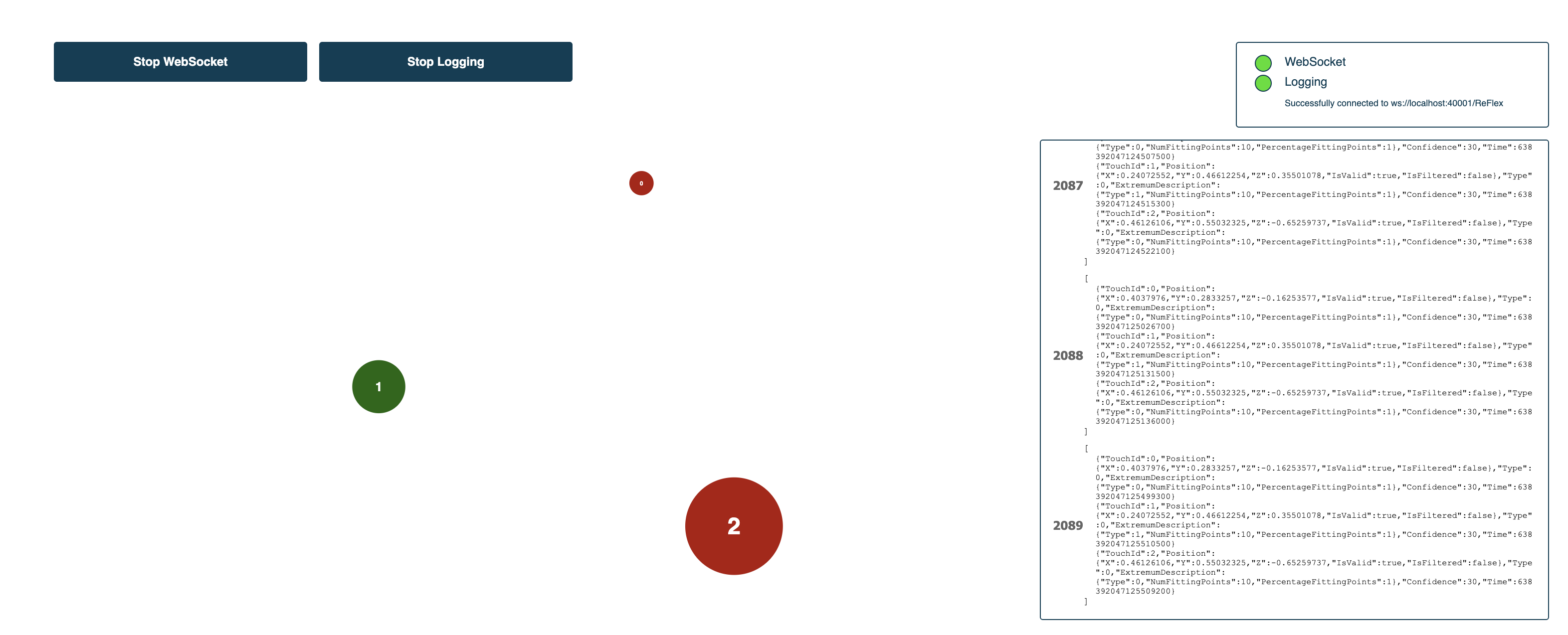
Logging backend):http://localhost:4302/ - Features:
- logs websocket messages to the screen (limited to last 100 messages, ordered chronologically)
- visualizes
InteractionswithTouchId,Position,Type(red:PUSH, green:PULL) - Depth value of Interaction is mapped to the size of the circle
- visualize connection state and connectivity to logging server
Code
1
2
3
4
5
6
7
8
9
10
11
12
13
14
15
16
17
18
19
20
21
22
23
24
25
26
27
28
29
30
31
32
33
34
35
36
37
38
39
40
41
42
43
44
45
46
47
48
49
50
51
52
53
54
55
56
57
58
59
60
    // open the websocket
    ws = new WebSocket(address);

    // event when connection to websocket is established
    ws.onopen = function() {
        const conn_msg = "Successfully connected to " + address;

        // remove button and display connection state
        showWebSocketState(conn_msg, true);
    };

    // event when websocket receives new interactions
    ws.onmessage = function (evt) {

        // update message number
        msgId += 1;

        // parse data
        const data = JSON.parse(evt.data);

        // display formatted message
        showMessages(msgId, data);

        // visualize messages on canvas
        showInteractions(data);

        // send interactions to logging server
        if (logMessages) {

            // log each interaction as separate data set
            const interactions = extractInteractions(data);
            interactions.forEach((msg) =>
            fetch(`${logAddress}log/data`, {

                // build message
                method: "POST",
                body: JSON.stringify({ message: msg }),
                headers: {
                    "Content-type": "application/json; charset=UTF-8"
                }
            })
            );
        }
    };

    // event when websocket connection is terminated
    ws.onclose = function() {
        const conn_msg = "Connection is closed...";

        // update button and connection state
        showWebSocketState(conn_msg, false);
    };

    // event for websocket error handling
    ws.onerror = function(error) {
        const conn_msg = `Connection Error: ${error}`;

        // update button and connection state
        showWebSocketState(conn_msg, false);
    }